In today’s hyper-connected workplace, digital distractions are silently sabotaging your productivity, costing you valuable time, focus, and career momentum every single day.

The average knowledge worker checks their email 15 times per day, switches between apps and websites nearly 300 times during work hours, and loses approximately 2.1 hours daily to digital interruptions. These aren’t just statistics—they represent a fundamental crisis in how we work in the modern era. The constant ping of notifications, the allure of social media, and the never-ending stream of messages have transformed our workplaces into battlegrounds where focus goes to die.
But here’s the empowering truth: you have more control over these distractions than you think. By implementing strategic approaches and understanding the psychology behind digital interruptions, you can reclaim your attention, multiply your output, and transform your work experience. This comprehensive guide will walk you through proven strategies that successful professionals use to eliminate digital distractions and unlock their full productive potential.
🧠 Understanding the True Cost of Digital Distractions
Before diving into solutions, it’s crucial to understand what’s actually happening when you get distracted. Digital interruptions don’t just steal the minutes you spend checking notifications—they trigger a cascade of cognitive costs that multiply their impact exponentially.
Research from the University of California, Irvine reveals that it takes an average of 23 minutes and 15 seconds to fully return to a task after an interruption. This phenomenon, known as “attention residue,” means that part of your brain continues processing the distraction even after you’ve returned to your primary task. When you check a Slack message mid-project, you’re not losing 30 seconds—you’re potentially losing nearly half an hour of peak cognitive performance.
The financial implications are staggering. Studies estimate that digital distractions cost the global economy over $650 billion annually in lost productivity. For individual workers, this translates to reduced career advancement opportunities, increased stress levels, and diminished quality of work output. The workplace distraction epidemic isn’t just an inconvenience—it’s a career-limiting condition that demands immediate attention.
📱 The Notification Nightmare: Taking Back Control
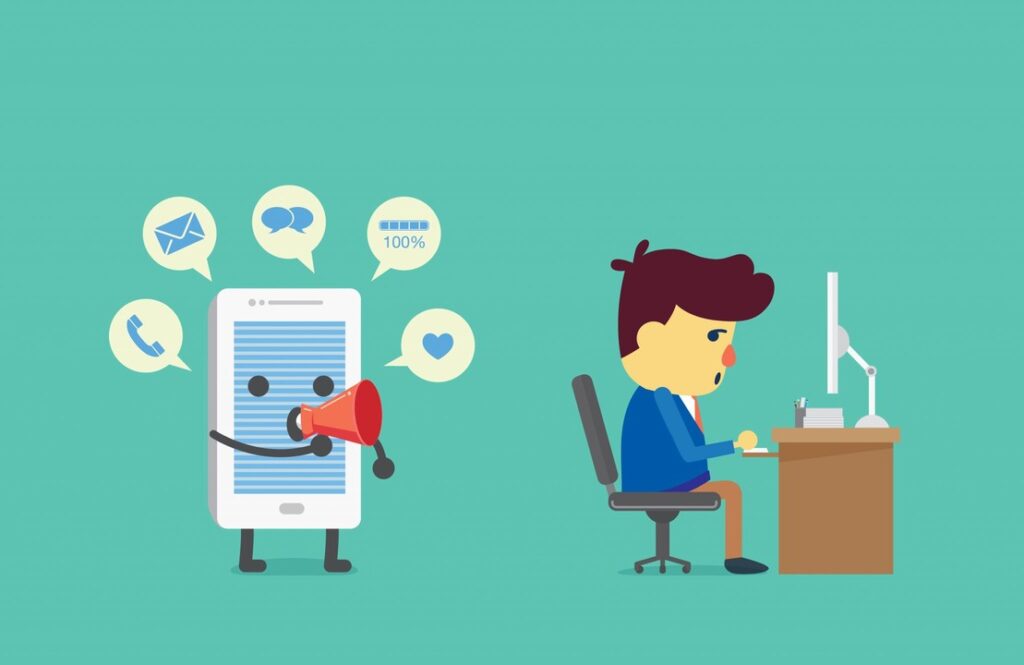
Notifications are designed with one purpose: to capture your attention immediately, regardless of what you’re doing. Tech companies employ teams of behavioral psychologists to make these alerts as irresistible as possible. Your first line of defense must be aggressive notification management.
Start by conducting a notification audit. For one full day, write down every notification you receive and honestly assess whether it required immediate attention. Most people discover that over 95% of notifications could have waited hours or even days without any negative consequence.
Implement these notification rules immediately:
- Disable all non-essential app notifications on your work devices
- Turn off email notifications completely—check email on your schedule, not when messages arrive
- Remove notification badges that show unread message counts
- Set your phone to “Do Not Disturb” mode during focused work blocks
- Use notification scheduling features to batch alerts during designated break times
- Keep only emergency contacts in your VIP list that can bypass Do Not Disturb
For those who struggle with manually managing these settings, dedicated focus apps can automate the process. Forest, for example, gamifies the focus experience by growing virtual trees during distraction-free periods.
⏰ Time Blocking: Your Secret Weapon Against Fragmentation
One of the most powerful strategies for eliminating digital distractions is time blocking—the practice of scheduling specific activities during predetermined time slots. This approach transforms your workday from a reactive scramble into a proactive mission.
Effective time blocking for digital distraction management involves creating distinct zones in your day: deep work periods where all digital communication is off-limits, communication windows where you batch-process emails and messages, and strategic break times where casual digital browsing is permitted.
A typical distraction-resistant schedule might look like this:
- 8:00-10:30 AM: Deep work block (all notifications off, email closed, phone in another room)
- 10:30-11:00 AM: Communication window (process emails, respond to messages, check updates)
- 11:00 AM-1:00 PM: Deep work block (maximum focus on high-priority projects)
- 1:00-1:45 PM: Lunch and digital break (browse freely, catch up on news)
- 1:45-3:30 PM: Collaborative work (meetings, team communications, lighter tasks)
- 3:30-5:00 PM: Final deep work or communication catch-up
The key principle is protecting your peak cognitive hours for work that requires uninterrupted focus while creating specific windows where digital communication receives your full attention. This approach actually improves your responsiveness because people learn when to expect replies from you.
🖥️ Digital Workspace Design: Environment Matters
Your digital environment significantly influences your susceptibility to distractions. Just as a cluttered physical desk creates mental chaos, a disorganized digital workspace invites constant interruptions and attention fragmentation.
Start with your browser. The average professional keeps 15-20 tabs open simultaneously, each one a potential distraction vector. Implement a strict tab discipline: close everything not directly related to your current task. Use bookmark folders to save pages for later rather than keeping tabs open as reminders.
Browser extensions can enforce digital boundaries. Tools like StayFocusd or LeechBlock allow you to block distracting websites during work hours, while News Feed Eradicator removes the infinite scroll from social media sites so you can access necessary features without falling into distraction rabbit holes.
Your desktop organization matters too. Remove all non-essential icons, disable desktop notifications, and consider using separate browser profiles or even separate user accounts for work versus personal activities. This physical separation creates psychological boundaries that reinforce focus.
📧 Email Management: Escaping the Inbox Trap
Email remains one of the most insidious productivity killers in the modern workplace. The expectation of constant availability and instant responses has transformed this communication tool into a digital leash that keeps professionals perpetually reactive.
Breaking free requires establishing clear email boundaries. First, abandon the fantasy of inbox zero as a daily goal—it’s unsustainable and counterproductive. Instead, implement a systematic email processing approach using designated time blocks.
The two-minute rule provides a practical decision framework: if an email can be addressed in under two minutes, handle it immediately during your communication window. Everything else should be scheduled, delegated, or batched with similar tasks. This prevents email from fragmenting your day into useless micro-tasks.
Set up aggressive email filters and folders to automatically sort incoming messages by priority. Use labels or categories to identify emails requiring action versus those that are simply informational. Consider implementing a challenge-response system for external emails to reduce spam and low-priority messages.
Most importantly, train your colleagues and clients by setting clear expectations about your response times. An email signature or auto-responder stating “I check email three times daily at 10:30 AM, 1:30 PM, and 4:30 PM” establishes boundaries while ensuring people know when to expect replies.
🤝 Managing Team Communication Without Constant Availability
The rise of instant messaging platforms like Slack, Microsoft Teams, and Discord has created an expectation of real-time availability that’s fundamentally incompatible with deep, focused work. The solution isn’t abandoning these tools but establishing team norms that respect focused work time.
Advocate for implementing “communication protocols” within your team. These agreements specify when synchronous communication is appropriate versus when asynchronous methods should be used. Urgent matters might warrant an immediate message, but most workplace communication isn’t truly urgent despite feeling that way.
Encourage your team to embrace threaded conversations and clear subject lines that allow people to prioritize messages without reading everything immediately. Use status indicators honestly—when you’re in deep work mode, your status should reflect that unavailability.
Schedule designated “collaboration hours” where team members are expected to be highly responsive, balanced with “focus hours” where interruptions should be minimized. This creates predictability that actually improves team coordination while protecting individual productivity.
🎯 The Pomodoro Technique: Structured Focus Intervals
The Pomodoro Technique offers a practical framework for maintaining focus in our distraction-saturated environment. This time management method involves working in focused 25-minute intervals (pomodoros) separated by short breaks, with longer breaks after completing four pomodoros.
During a pomodoro, you commit fully to a single task with zero digital distractions. Phone goes off, email stays closed, messaging apps are quit entirely. This creates a manageable focus challenge—anyone can resist distractions for just 25 minutes—while the scheduled breaks provide guilt-free opportunities to check messages and scratch digital itches.
The technique works because it aligns with our natural attention spans while providing structure that prevents work from expanding indefinitely. The regular breaks also serve as rewards that make focus periods more psychologically sustainable.
Numerous apps can help implement this technique. Focus To-Do combines Pomodoro timers with task management, helping you structure your entire workday around focused intervals.
🧘 Building Digital Mindfulness: The Long-Term Solution
While tactics and tools provide immediate relief from digital distractions, sustainable productivity requires developing what might be called “digital mindfulness”—an ongoing awareness of your technology relationship and intentionality about how you engage with digital tools.
Digital mindfulness starts with regular self-reflection. At the end of each workday, spend five minutes reviewing when you got distracted, what triggered those distractions, and how they impacted your productivity. This metacognitive practice builds awareness that gradually strengthens your ability to resist future distractions.
Practice the “pause principle” before engaging with any digital stimulus. When you feel the urge to check your phone, open email, or browse a website, pause for three conscious breaths and ask yourself: “Is this action aligned with my current priorities?” This tiny intervention creates space between impulse and action where intentional choice becomes possible.
Develop replacement behaviors for digital distraction habits. When you feel the urge to check social media during a difficult work task, stand up and stretch instead, or grab a glass of water. By substituting the habitual response, you gradually weaken the neural pathways that drive compulsive digital checking.
📊 Measuring Progress: Data-Driven Distraction Reduction
What gets measured gets managed. Tracking your digital behavior provides concrete data about your distraction patterns and progress toward improved focus. Several tools can illuminate your digital habits in revealing ways.
Screen time tracking apps show exactly how much time you spend in various applications and how frequently you unlock your devices. This objective data often shocks people into recognizing how severe their distraction problem has become. Seeing that you checked your phone 127 times yesterday creates powerful motivation for change.
RescueTime runs quietly in the background on your computer and phone, categorizing your activities and generating detailed reports about productive versus distracting time. The app can also block distracting websites during scheduled focus periods.
Establish baseline metrics before implementing changes, then track weekly progress. Useful metrics include: total focused work hours per day, number of times checking email, average time between digital interruptions, and self-rated focus quality on a 1-10 scale. Watching these numbers improve provides motivation and reveals which strategies work best for your specific situation.
🚀 Creating a Distraction-Resistant Culture
Individual strategies provide significant benefits, but truly eliminating digital distractions often requires cultural changes within teams and organizations. If your workplace culture expects instant responses and constant availability, individual resistance becomes exhausting and potentially career-limiting.
Become an advocate for focus-friendly policies within your organization. Share research about the productivity costs of constant interruptions. Propose implementing company-wide “no meeting” days where everyone protects time for deep work. Suggest establishing core collaboration hours balanced with protected focus time.
Lead by example in your own communication patterns. Respond thoughtfully rather than instantly. Send fewer but more substantive messages. Respect others’ focus time by choosing asynchronous communication methods when appropriate. Your behavior signals to others that immediate availability isn’t necessary for professional success.
Celebrate and recognize deep work accomplishments within your team. When focus-friendly behaviors lead to exceptional output, make that connection explicit. This gradually shifts organizational values away from performative busyness toward meaningful productivity.
💪 Sustaining Your Focus Transformation
Eliminating digital distractions isn’t a one-time project but an ongoing practice that requires sustained commitment and periodic recalibration. Digital technology evolves constantly, introducing new distraction vectors that require updated defenses.
Schedule quarterly “digital audits” where you review all your devices, apps, notification settings, and digital habits. Technology creep is real—apps you disabled months ago may have re-enabled notifications after updates, new social platforms may have infiltrated your attention, and old habits may have gradually resurface.
Build accountability structures that support your focus goals. Share your distraction-reduction commitments with colleagues or friends who will check in on your progress. Consider joining or forming a “focus accountability group” where professionals committed to deep work meet weekly to share challenges and successes.
Remember that perfection isn’t the goal—progress is. You’ll have days when distractions win, when you fall back into old patterns, when that notification proves irresistible. These aren’t failures but opportunities to learn about your triggers and strengthen your strategies. Sustainable productivity comes from consistent effort over time, not from flawless execution.
The digital distractions plaguing modern workplaces aren’t inevitable features of professional life—they’re challenges with practical solutions. By implementing the strategies outlined here, from aggressive notification management to time blocking, from digital workspace design to mindfulness practices, you can reclaim your attention and unlock productivity levels you may have thought impossible. Your focus is your most valuable professional asset. Guard it fiercely, cultivate it deliberately, and watch as your career transforms in response to your newfound capacity for deep, meaningful work.