Your home office holds untapped potential to revolutionize how you work. Let’s explore how mindful workspace design can transform scattered attention into sustained focus and creative breakthroughs.

🧠 The Psychology Behind Workspace Design
The environment surrounding us shapes our cognitive performance more profoundly than most realize. Research in environmental psychology demonstrates that physical spaces directly influence mental states, affecting everything from concentration levels to creative problem-solving abilities. When we intentionally design our workspaces, we’re essentially programming our brain’s productivity operating system.
Neuroscience reveals that our brains constantly scan environments for threats, distractions, and opportunities. In cluttered or chaotic spaces, this scanning process consumes mental bandwidth that could otherwise fuel focused work. Conversely, mindfully arranged workspaces reduce cognitive load, allowing our prefrontal cortex to dedicate more resources to the task at hand.
The concept of “environmental cues” plays a crucial role here. Every object, color, and spatial arrangement sends subtle signals to your subconscious mind. A pile of unfinished projects signals overwhelm. A clear desk with intentional design elements signals readiness and capability. Understanding these psychological principles empowers you to architect spaces that align with your productivity goals.
🎨 Color Psychology and Cognitive Performance
Color choices in your home office aren’t merely aesthetic decisions—they’re productivity tools. Different wavelengths of light affect our brain chemistry, influencing mood, energy, and cognitive function in measurable ways.
Blue tones stimulate mental clarity and focus, making them ideal for analytical work requiring sustained concentration. Research shows blue environments can enhance productivity by up to 15% for detail-oriented tasks. Green, associated with nature and balance, reduces eye strain while promoting creative thinking and stress reduction. It’s particularly effective for spaces where you alternate between focused work and creative brainstorming.
Warm colors like yellow and orange energize spaces, boosting optimism and stimulating social interaction—perfect if you frequently participate in video calls or collaborative work. However, excessive use can create overstimulation. Red increases heart rate and creates urgency, which might benefit spaces where you tackle time-sensitive projects but can induce stress if overused.
Neutral tones—grays, beiges, and whites—provide versatility and calm, serving as excellent base colors that allow you to introduce accent colors strategically through artwork, plants, or accessories. The key is understanding your work type and choosing colors that support your specific cognitive needs throughout the day.
💡 Lighting: The Foundation of Focus
Lighting profoundly impacts circadian rhythms, mood regulation, and visual comfort. Poor lighting ranks among the top workspace complaints and contributes significantly to eye strain, headaches, and afternoon energy crashes that derail productivity.
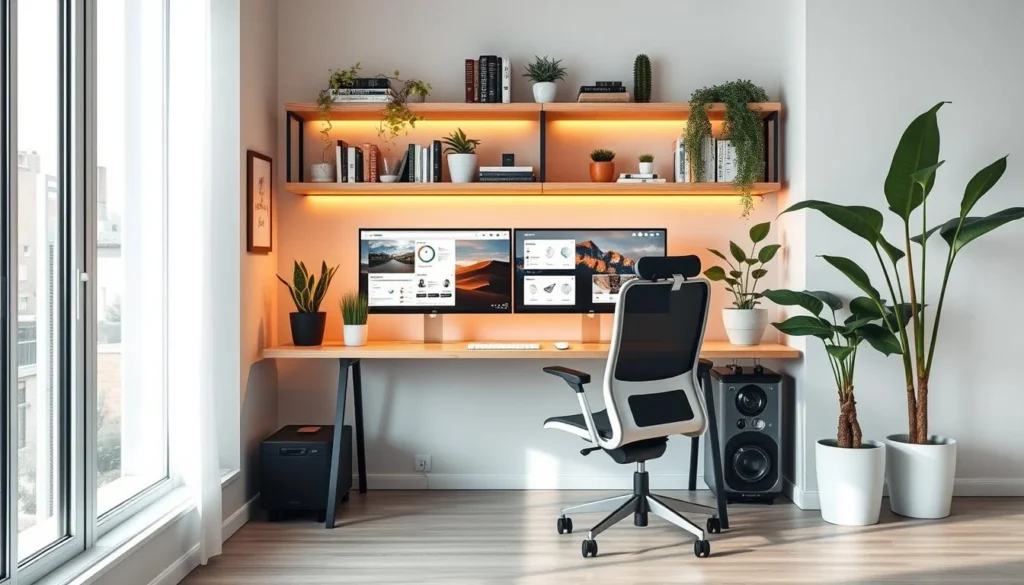
Natural light reigns supreme for home office environments. Positioning your desk near windows provides vitamin D exposure, regulates melatonin production, and enhances mood through full-spectrum light exposure. Studies consistently show that workers with access to natural light report better sleep quality, increased physical activity, and higher quality of life scores.
When natural light proves insufficient, implement a layered lighting strategy. Task lighting—adjustable desk lamps with 4000-5000K color temperature—provides focused illumination for detailed work without harsh shadows. Ambient lighting fills the room with gentle, diffused light that prevents screen glare and reduces eye strain. Consider smart bulbs that adjust color temperature throughout the day, mimicking natural light patterns to support your circadian rhythm.
Avoid positioning screens directly facing windows, which creates glare and forces your eyes to constantly adjust between extreme brightness levels. Instead, place windows perpendicular to your primary viewing angle, allowing natural light to illuminate your space without compromising screen visibility.
🪑 Ergonomics: Where Comfort Meets Performance
Physical discomfort fragments attention. When your body sends pain signals, your brain diverts resources from productive work to address those signals. Ergonomic workspace design eliminates these distractions, creating physical conditions where sustained focus becomes effortless.
Your chair represents your single most important furniture investment. Quality ergonomic chairs support natural spinal curves, distribute weight evenly, and adjust to your body’s unique dimensions. Key features include adjustable seat height, lumbar support, armrests at elbow height, and breathable materials. The “90-90-90 rule” provides a starting point: 90-degree angles at ankles, knees, and hips when seated.
Desk height matters equally. Your forearms should rest parallel to the floor when typing, with wrists in neutral positions. Monitor positioning follows the “arm’s length, eye level” principle—the top of your screen should sit at or slightly below eye level, approximately an arm’s length away. This positioning prevents neck strain and reduces the forward head posture that causes chronic tension.
Standing desk converters or adjustable-height desks introduce movement variation that combats sedentary work hazards. Alternating between sitting and standing throughout the day improves circulation, reduces back pain, and provides natural energy boosts. Start with 20-30 minute standing intervals, gradually increasing as your body adapts.
🌿 Biophilic Design: Bringing Nature Indoors
Humans possess an innate connection to nature—a phenomenon scientists call “biophilia.” Integrating natural elements into home offices taps into this evolutionary programming, reducing stress hormones while enhancing cognitive function and creativity.
Indoor plants serve as living air purifiers while providing psychological benefits that extend beyond aesthetic appeal. Snake plants, pothos, and ZZ plants thrive in various light conditions with minimal maintenance. Studies from the University of Technology Sydney found that plants in office environments reduced stress by 37%, anxiety by 58%, and fatigue by 38%.
Natural materials—wood desks, bamboo accessories, stone elements—create tactile connections to nature that synthetic materials cannot replicate. These materials often possess unique textures and imperfections that add visual interest without cluttering the space.
Nature views and imagery also provide cognitive benefits. If windows don’t offer natural vistas, high-quality nature photography or artwork depicting landscapes can reduce stress and improve focus during brief visual breaks. The key is selecting images that evoke tranquility rather than stimulation—gentle seascapes, forest scenes, or mountain ranges work particularly well.
📱 Technology Integration Without Digital Overwhelm
Modern productivity requires technology, yet devices often become our greatest distraction sources. Mindful workspace design establishes boundaries that harness technology’s benefits while minimizing its attention-fragmenting potential.
Cable management sounds mundane but profoundly impacts mental clarity. Tangled cables create visual chaos that subtly elevates stress levels. Invest in cable sleeves, under-desk trays, and wireless charging stations to eliminate wire clutter. This organization also simplifies device connectivity and reduces the friction of switching between tasks.
Dedicated device zones prevent technology sprawl. Designate specific locations for phones, tablets, and secondary devices. When devices have “homes,” you’re less likely to leave them in your primary work zone where notifications interrupt deep focus. Consider a charging station outside your immediate line of sight for personal devices during work hours.
Monitor arrangement for multi-screen setups requires thoughtful planning. Position your primary monitor directly in front, with secondary screens angled slightly inward at about 30 degrees. This arrangement minimizes head rotation and maintains focus on your central work area. Ensure all screens match in height and distance to prevent constant focal adjustments that cause eye fatigue.
Focus-enhancing applications help manage digital distractions. Forest gamifies concentration by growing virtual trees during focus sessions, creating visual rewards for sustained attention. Setting your phone to these focus modes during deep work blocks significantly reduces interruption frequency.
🎵 Soundscaping Your Productive Environment
Acoustic environment dramatically influences concentration quality. While complete silence works for some, most people benefit from intentional soundscapes that mask distracting noises while supporting cognitive performance.
White noise and ambient sounds create consistent audio backgrounds that prevent sudden noises from breaking concentration. Ocean waves, rainfall, or coffee shop ambiance provide gentle sound masking without demanding attention. Research indicates that moderate ambient noise levels (around 70 decibels) can enhance creative thinking by promoting abstract processing.
Music selection depends on task type. Instrumental music without lyrics supports focus for most cognitive work, as lyrics can interfere with language processing. Classical music, lo-fi hip-hop, or ambient electronic genres provide rhythmic structure without competing for verbal attention. For repetitive tasks requiring less cognitive load, familiar music with lyrics may boost mood and energy without hindering performance.
Physical sound management also matters. Acoustic panels, heavy curtains, or bookshelves filled with books absorb sound waves and reduce echo in hard-surfaced rooms. If household noise proves unavoidable, quality noise-canceling headphones represent worthwhile investments that pay dividends in recovered focus time.
🧘 Creating Zones for Different Work Modes
Peak productivity requires transitioning between focused execution, creative exploration, and reflective planning. Workspace zones that support these distinct modes enable smoother cognitive transitions and prevent mental fatigue from prolonged single-mode thinking.
Your primary workspace should optimize for deep focus—your desk positioned to minimize visual distractions, with necessary tools immediately accessible. This zone embodies efficiency and concentration, free from items that don’t serve your core work functions.
A creative corner encourages different thinking patterns. This might include a comfortable chair positioned differently from your work desk, a small table for sketching or mind-mapping, or simply a space where you face a different direction. Changing physical perspective often triggers mental perspective shifts that unlock creative insights. Keep inspirational materials, sketchbooks, or brainstorming tools in this zone.
A reflection zone supports planning and review—perhaps a cozy reading chair with good natural light where you start mornings with priority-setting or end days with reflection practices. This spatial separation signals to your brain that you’re shifting into different cognitive modes, making transitions more efficient.
🗂️ Strategic Organization Systems
Clutter isn’t merely visual—it’s cognitive. Every visible item represents an unmade decision or uncompleted task that occupies mental RAM. Strategic organization systems free cognitive resources for productive work rather than environmental management.
The “one-touch rule” minimizes clutter accumulation. When items enter your workspace, immediately assign them to specific destinations rather than creating temporary “I’ll deal with this later” piles. This habit prevents clutter creep and maintains your carefully designed environment.
Vertical storage maximizes space efficiency while keeping essentials accessible. Wall-mounted shelves, pegboards, or magnetic boards utilize overlooked vertical surfaces, keeping desk surfaces clear for active work. The visibility of vertical storage also makes retrieval easier than digging through drawers.
Filing systems should match your retrieval patterns, not aesthetic ideals. If you’re visual, clear containers or open shelving might work better than opaque storage. If you’re digital-first, minimize physical files but ensure digital organization mirrors logical categorization. The best system is the one you’ll actually maintain consistently.
⚡ Personalization That Inspires Without Distracting
Your workspace should reflect your identity and values, creating emotional connection and motivation. However, personalization requires balance—too many personal items create visual clutter, while sterile environments feel emotionally disconnected.
Curate meaningful objects rather than accumulating decorative clutter. A single piece of meaningful art impacts mood more positively than scattered decorations. Family photos in designated spots provide emotional grounding without overwhelming your visual field. Achievement reminders—certificates, awards, or completed project artifacts—boost confidence during challenging work moments.
Vision boards or goal visualizations can powerfully influence motivation when positioned appropriately. Place these in reflection zones rather than primary work areas, where they provide inspiration during planning sessions without distracting during execution phases.
Rotate personal items seasonally or project-based. This practice keeps your environment fresh and prevents habitation—the psychological process where our brains stop noticing familiar stimuli. Regular rotation maintains emotional impact and prevents your workspace from feeling stale.
🌅 Rituals That Activate Your Productive Mindset
Physical spaces gain power through consistent use patterns. Establishing workspace rituals creates psychological associations that trigger productive mindsets, essentially programming your brain to enter focus mode when you enter your workspace.
Morning workspace preparation signals work mode initiation. Simple actions—opening blinds for natural light, brewing tea, reviewing priorities, or arranging your desk—create transition rituals that separate home life from work focus. These rituals prove especially valuable when working from home, where physical and professional boundaries blur.
End-of-day completion rituals restore order and create closure. Spending five minutes tidying your desk, filing materials, and writing tomorrow’s top priorities creates clear boundaries between work and personal time. This practice prevents work anxiety from bleeding into evening hours while ensuring you start fresh each morning.
Regular maintenance schedules preserve your intentional design. Weekly desk clearing, monthly organization reviews, and quarterly design reassessments prevent gradual deterioration of your productivity-optimized environment. These small investments compound into sustained workspace effectiveness.
🔄 Adapting Your Space to Energy Rhythms
Productivity isn’t constant throughout the day. Understanding your personal energy patterns and adapting your workspace accordingly maximizes output during peak hours while supporting necessary recovery during natural energy dips.
Most people experience peak cognitive performance 2-4 hours after waking, with secondary peaks in late afternoon. Schedule demanding analytical work during these windows, positioning yourself in your primary focus zone with optimal lighting and minimal distractions.
Energy dips typically occur mid-afternoon. Rather than fighting natural rhythms, adapt activities and environment accordingly. This might mean transitioning to your creative zone for brainstorming, taking walking breaks, or handling routine administrative tasks that require less cognitive intensity.
Environmental adjustments support these transitions. Brightening lights signals focus time, while dimming and shifting to warmer tones in late afternoon supports your natural wind-down process. Temperature adjustments—cooler for alertness, warmer for creative thinking—subtly influence cognitive state throughout the day.
✨ Transforming Space Into Productivity Catalyst
Your home office represents more than square footage—it’s a productivity technology as powerful as any software tool. By intentionally designing environments that support focus, creativity, and wellbeing, you create competitive advantages that compound daily.
Implementation doesn’t require perfection or significant investment. Start with high-impact, low-cost changes: decluttering surfaces, optimizing lighting, repositioning your desk for better natural light, or introducing a single plant. Small improvements accumulate into transformative environments.
Remember that ideal workspaces evolve with your needs. What optimizes productivity for intense project work might differ from spaces supporting collaborative creativity or strategic planning. Give yourself permission to experiment, adjust, and continuously refine your environment as you discover what genuinely enhances your focus and creativity.
The most productive workspace is ultimately the one that feels intuitively right for your unique work style, cognitive patterns, and professional demands. Trust your experiences, measure your results, and keep iterating toward the environment where your best work naturally emerges. Your mindfully designed home office becomes not just where you work, but a strategic asset that unlocks your full productive potential day after day.